Wednesday, October 26

All About Energy

I helped a 3rd grade homeschool group learn about energy.  (Florida Next Generation Sunshine State Standards Big Idea 10: Forms of Energy Benchmarks: SC.3.P.10.1, SC.3.P.10.2)

We watched a quick video (Peekaboo Kidz - The Dr.  Binocs Show: Energy)
Then students created a graphic organizer on energy including -  forms of energy (potential & kinetic) and types of energy (light, heat, sound, electrical, mechanical, chemical & gravitational).
Booklet includes fill in the blank vocabulary, a concept map, cut and paste examples and a word find.

Students took the booklet home to share with their families however it would be a good activity as part of an interactive notebook.

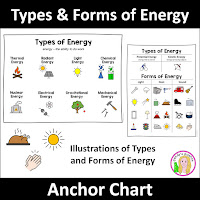
I displayed  the Types & Forms of Energy Anchor Charts for students to use as a reference.
We had some time at the end of class so we demonstrated the change from potential to kinetic energy with wind up boats.  I cut a template out of take-out containers and added a rubber band and paper clip.  We raced in wallpaper trays. 

Wednesday, September 14

Student Led Test Review

Students don't look forward to reviewing for assessments.

With this board game, students can review for the Science semester exam and have fun.


There are 58 questions that cover the standards for Nature of Science, Matter and the Periodic Table.

The answers are included on the game cards so students receive immediate feedback.

As students are playing/reviewing, I can monitor their progress and give struggling students individual attention.

Students are engaged and I’m able to quickly determine if they’re prepared!

Sunday, August 28

Using Cornell Notes in Science

Benefits of using Cornell Note outlines for your students

  • Notes are organized 
  • Students can quickly identify key words and concepts
  • Notes can be used as a study guide


How to Use Sandy’s Science Cornell Notes

1. Start with an outline 
    • Standard and Composition Sizes are both included

2. Use resources to fill in

3. Check student’s answers or use the answer key for direct instruction for students that need differentiation.


4. Glue into an interactive notebook. 

Students can refer back to these notes as homework, a reference for an exit ticket/formative assessment or as a study guide for a summative assessment.

Saturday, August 27

Rockets - Back to the Moon

NASA is launching Artemis on Monday August 29th. (Sep 2nd & 5th are alternate days).  
The launch window on the 29th is between 8:33 a.m. EDT and 10:33 a.m. EDT (12:33 and 14:33 UTC).

There is a new website and video:  


Students need to know the advantages of multistage rockets.  This launch is a good way to show them!
Students can fill in a Cornell (2 column) Notes Outline that includes Key Terms, Questions and Summary prompt about the Science of Rockets (thrust, velocity, multistage).


Tuesday, August 23

Are you setting up your sub plan folder?

Here are a few ideas to leave for a sub or have ready in case a collegue is out and you're asked at the last minute to cover...

Scientific Method

    • Watch a Mythbusters video clip

    • Determine the parts of the experiment
      • Hypothesis
      • Identify the Variables - Independent variable (IV), Dependent variable (DV) & Controls
      • Conclusion - Was the hypothesis supported or not?
*If you have sets of Jenga - let students try it!

Graphs

  • Use a graph from the Graph of the Week site

  • Identify the parts of a graph
    • Title
    • Independant variable (IV)
    • Dependant variable (DV)
  • Identify any trends (positive, negative, no trend)

I have a folder with copies and answer keys ready to go.  If I don't use them - they're ready to use next year.

Have a great year!


Thursday, May 19

Don't have a Brain POP Subscription? Here's another option.

 I'm lucky to have a school that pays for a Brain POP subscription - it's really expensive!!!

Scholastic has a pretty good alternative that's FREE!!!!  It's called Study JAMS! and in some cases I like it better.  

Tides is a topic that I think Scholastic does a better job.  They include the Sun, moon, Earth relationship, high/low tides but they also discuss Spring and Neap tides which is part of our state's standards.


I made CLOZE notes to go along with the video.  My students need to have a purpose for watching a video to be engaged.  We watch it together once then decide if we need to go back and watch additional times to get the notes completed or review main ideas.  It's not unusual to re-watch 3-5 times.  *5 for chemical/physical changes was our record!

Did I mention the best part about Scholastic Study JAMS?  You can download the video to play offline. 


There is a playback speed option too.  I use this when the facts are presented quickly.  Students like this option because it means less times they need to re-watch.

To introduce tides, I use a wordfind as a warm-up, watch the video and complete notes and then a crossword as either a wrap-up or as homework.  The next class we'll do a cut and paste/sort or a more advanced graphing activity  (I like this one from Middle School Science - I adapted it and used our local tide data.)

The only drawbacks to using Study JAMS! is there are not closed captions and they don't have all the topics BrainPOP does.  I still think it's a great alternative!

Tuesday, May 17

Brain POP Tides Guided Notes

To introduce the topic of tides - I use CLOZE or guided notes in my classroom. 

I find completing notes while watching a video keeps students engaged.

BrainPOP requires a subscription - not included in the product


Here's how I suggest using the product:

  1. Start with the word search (included) as a warm-up to introduce vocabulary terms before watching the video.
  2. Next, Students watch the video and fill in the notes as they go. *After the video I ask students if they need to watch the video again. We have watched the videos several times in some cases. I let the students decide. *I walk around as the video plays to monitor student progress.
  3. Review the answers together and have students glue the notes in their interactive notebooks for a reference.
  4. Use the crossword (included) as a formative assessment to wrap-up. *There is a word bank to reinforce the vocabulary.
An Easel by TpT is included in each product. It has fill in notes just like the print copy and a link for the video (you'll need to provide students the username and password - not included).